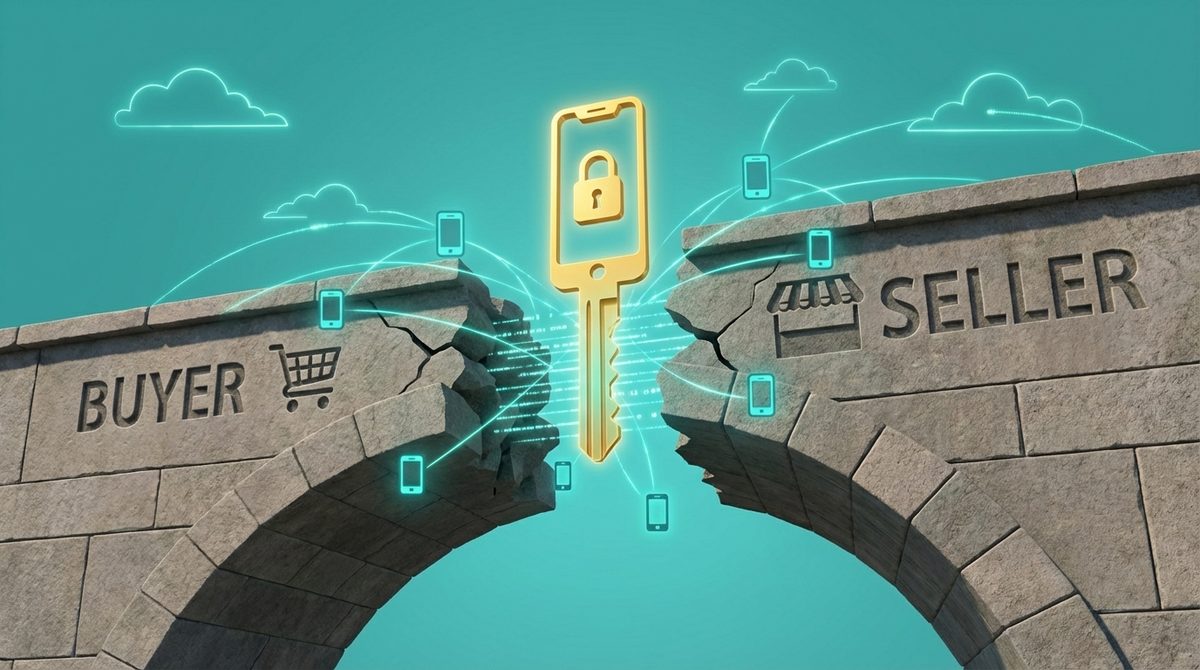
Here is a number that should alarm anyone building or using e-commerce in Africa: $5 billion. That is how much the continent loses every year — not to fraud, not to theft, but to distrust (PYMNTS 2024). It is the value of transactions that never happen because buyers and sellers do not trust each other enough to complete the deal.
And here is the number that explains why: 49%. That is the percentage of African consumers who avoid online shopping entirely because of trust concerns (UNCTAD 2024). Not because they do not have smartphones. Not because they do not have mobile money. Not because they do not want to buy online. They avoid it because they do not trust the process.
This is not a technology problem. This is a trust problem. And TandPay was built specifically to solve it — starting in Rwanda.
Understanding the Trust Gap
The trust gap in African e-commerce is not one problem — it is a chain of interconnected failures. To understand how TandPay solves it, you need to understand each link in that chain.
Failure 1: No buyer protection on mobile money
When you send money via MTN MoMo to buy a product, the transaction is final and irreversible. If the seller never delivers, MoMo cannot help you. The money is gone. This is the foundational trust failure — the one that makes all others possible.
How TandPay fixes it: Payment goes into escrow, not to the seller. The seller cannot access the money until the buyer confirms delivery. If the seller never delivers, the buyer gets their money back through the dispute process.
Failure 2: No proof of delivery
Even when both parties are honest, disputes arise because there is no way to prove delivery happened. The seller says "I delivered." The buyer says "I never received it." Without evidence, it is impossible to resolve fairly.
How TandPay fixes it: The 4-digit delivery code creates a digital, timestamped record. When the buyer enters the code, it is undeniable proof that they received the product. No more he-said-she-said.
Failure 3: No seller verification
On WhatsApp and Instagram, anyone can claim to be a legitimate seller. There are no reviews, no track records, no verification systems. A buyer has no way to distinguish a trustworthy seller from a scammer before sending money.
How TandPay fixes it: Every seller on TandPay has a public profile with a trust score, order count, and buyer reviews. New buyers can check a seller's track record before purchasing — real data, not promises.
Failure 4: No dispute resolution
When something goes wrong with a WhatsApp transaction, there is no system to resolve it. The buyer and seller are left to argue directly. Most of the time, whoever has less power — financially, socially, or emotionally — absorbs the loss.
How TandPay fixes it: TandPay has a formal dispute resolution process. The buyer reports an issue within 1 hour of delivery. Both sides submit evidence. A TandPay admin reviews the case and makes a binding decision. Fair, neutral, evidence-based.
The Cash-on-Delivery Trap
Africa's most visible symptom of the trust gap is the dominance of cash on delivery (COD). When people do not trust online payments, they insist on paying only when they see the product in person:
- Morocco: 74% of e-commerce transactions are COD
- Egypt: 60% COD
- Kenya: 40% COD
COD seems like a reasonable solution from the buyer's perspective — you only pay when you receive the goods. But it creates massive problems for sellers and the ecosystem:
- Failed deliveries. Buyers order products with no commitment. When the delivery arrives, they change their mind or are not available. The seller has already paid for shipping and packaging — those costs are lost.
- Cash handling risks. Delivery riders carry large amounts of cash, creating security risks.
- No prepayment = no trust signal. A buyer who has not paid has no skin in the game. COD attracts window-shoppers and time-wasters who would never complete a prepaid transaction.
- Jumia's 22% cancellation rate. Jumia, Africa's largest e-commerce platform, reported a 22% customer fulfillment default rate in their SEC filings — largely driven by COD. Nearly one in four orders is cancelled after the seller has processed and shipped it.
COD is not a solution — it is a symptom
Cash on delivery does not solve the trust problem. It shifts the risk entirely onto the seller. Escrow is the only mechanism that protects both sides simultaneously: the buyer knows their money is safe, and the seller knows the buyer is committed.
The Real Cost of Fraud: $4.60 for Every $1 Stolen
When people think about fraud costs, they think about the money stolen. If a scammer takes 10,000 RWF, the loss is 10,000 RWF. Right?
Wrong. According to LexisNexis Risk Solutions (2024), every $1 of fraud actually costs merchants $4.60 in sub-Saharan Africa. That multiplier includes:
- The lost product/payment itself — the direct financial loss
- Investigation and resolution time — staff hours spent chasing the issue
- Lost future sales — customers who experienced or heard about fraud and never return
- Reputation damage — the long-term erosion of trust that reduces conversion rates
- Operational costs — implementing manual fraud checks that slow down legitimate transactions
For a small seller on WhatsApp, that $4.60 multiplier is even more devastating. A woman selling clothes who loses a 20,000 RWF order to fraud does not just lose 20,000 RWF. She loses the product she cannot replace, the hours she spent communicating with the buyer, the delivery costs she incurred, and potentially other customers who heard about the bad experience and chose to shop elsewhere.
The math: TandPay vs. fraud
TandPay charges a 2.5% platform fee. On a 20,000 RWF transaction, that is 500 RWF. Compare that to the cost of one fraudulent transaction at the $4.60 multiplier: 20,000 x 4.60 = 92,000 RWF in total economic impact. Escrow at 2.5% is 184 times cheaper than the real cost of fraud. Prevention is not just better than cure — it is overwhelmingly cheaper.
Rwanda's Trust Opportunity
Rwanda is uniquely positioned to solve the trust gap, and here is why: the country has already proven that it can build trust infrastructure at national scale. Consider what Rwanda has accomplished:
- Ranked #1 in Africa on the World Bank's B-READY index (2024-2025) for ease of doing business
- 96% financial inclusion (FinScope 2024) — nearly every Rwandan has access to financial services
- 86% mobile money adoption — one of the highest in the world
- 75+ registered fintech companies — up from just 3 in 2014
- Progressive digital commerce regulation under BNR and RURA
Rwanda built the highways. It built the financial infrastructure. It built the regulatory framework. But there is one piece missing: transaction-level trust. The kind of trust that operates not at the system level, but at the level of every individual buyer-seller interaction.
That is what TandPay provides. Not trust in the banking system — Rwandans already trust that. Not trust in mobile money — that is established. But trust in the specific person you are buying from or selling to on WhatsApp. TandPay makes individual transactions safe, even between strangers.
Why Reputation Systems Are Not Enough
Some platforms try to solve the trust problem with reviews and ratings. "Check the seller's reviews before buying." It sounds logical, but reputation systems have fundamental flaws in social commerce:
- Reviews can be faked. Creating fake positive reviews is trivial. A scammer can build a 5-star profile with fabricated transactions before targeting real victims.
- Reviews are platform-specific. A seller's reputation on Instagram does not transfer to WhatsApp, Facebook, or TikTok. Every platform is a fresh start — including for scammers.
- Reviews do not prevent loss. Even if a seller has bad reviews, a buyer who already sent money is out of luck. Reviews are informational, not protective. They warn you, but they do not save you.
- New sellers have no reviews. How does a legitimate new seller build trust from zero? Reputation systems create a chicken-and-egg problem that punishes honest newcomers.
TandPay's approach is fundamentally different. Reputation (trust scores, reviews) is informational — it helps buyers make decisions. But escrow is structural — it makes the transaction itself safe regardless of reputation. Even if a seller has zero reviews, the buyer's money is protected. You do not need to trust the seller. You trust the escrow.
The Escrow Market Is Exploding — Africa Should Lead
The global escrow services market is projected to grow from $3.46 billion in 2024 to $21.49 billion by 2032 (Fortune Business Insights). That is a 6x increase in eight years, driven primarily by the growth of digital commerce in emerging markets.
Africa, with its $1.1 trillion mobile money ecosystem and rapidly growing social commerce sector, should be at the forefront of this growth. The continent has the largest population of mobile money users, the highest social commerce engagement rates, and the most acute trust deficit. The need for escrow is greater here than anywhere else in the world.
TandPay is building this infrastructure in Rwanda — but the model is designed to scale. Every African market with mobile money and social commerce has the same trust gap. The solution is the same: an escrow layer that sits on top of existing payment rails and makes commerce safe.
How TandPay Solves Every Trust Failure
Let us bring it all together. Here is every trust failure in African social commerce and exactly how TandPay addresses it:
- "I sent money but never got the product." → Escrow holds money until delivery is confirmed. If no delivery, dispute and refund.
- "The buyer says they never got it, but I delivered." → 4-digit delivery code is timestamped proof of receipt.
- "I don't know if this seller is legit." → Public seller profile with trust score, order count, and real reviews.
- "Something went wrong and there's no one to help." → Formal dispute resolution: buyer reports within 1 hour, then admin review follows the support SLA.
- "I don't want to pay before seeing the product." → Escrow means your money is protected — you are not paying the seller, you are securing the transaction.
- "Who goes first — buyer or seller?" → Neither. Escrow neutralizes the question. Both sides are protected simultaneously.
This is not incremental improvement. This is structural change. TandPay does not make unsafe transactions slightly safer. It makes them fundamentally safe by design.
Stop Losing to Distrust
The $5 billion trust gap is not inevitable. It exists because the infrastructure to solve it did not exist — until now. Escrow technology has been used for centuries in traditional commerce. TandPay is bringing it to mobile money commerce in the simplest possible form: a payment link, an escrow hold, a delivery code, and fast payout after the inspection window.
If you are a buyer, you deserve to know your money is safe before the product arrives. If you are a seller, you deserve to know you will get paid after you deliver. Both of these are possible today with TandPay.
The trust gap costs Africa $5 billion a year. How much has it cost you? Read more about how to protect yourself: 5 Signs of an Online Shopping Scam in Rwanda.
Stop Losing Sales to Distrust
Whether you are buying or selling, TandPay protects your money with escrow. Start a safe deal in under 2 minutes.
Start a Safe Deal on TandPay