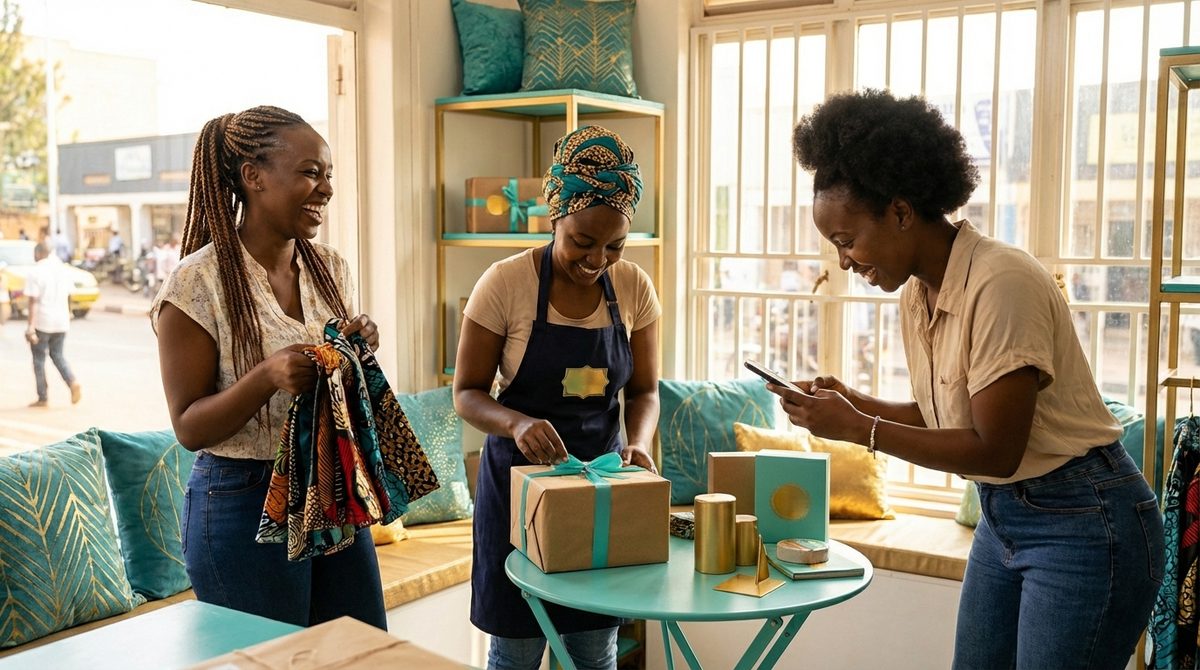
Walk through any market in Kigali, Kimironko, or Nyamirambo, and you will notice something that the data confirms: women are the backbone of Rwanda's commerce. They run the stalls. They negotiate the deals. They manage the supply chains. And increasingly, they are taking that same energy online — selling on WhatsApp, Instagram, and TikTok.
But here is the problem nobody is solving: the women who drive Africa's social commerce are also the ones most vulnerable to its trust failures. When a buyer ghosts after receiving a product, when a seller takes payment and never delivers, when a dispute has no resolution — women bear the brunt. They lose inventory they cannot afford to replace. They lose customers they worked months to build. And too often, they lose confidence in selling online altogether.
TandPay was built to change that. Not as a women-only platform — but as a system designed around the exact problems that disproportionately affect women in informal trade.
The Numbers Tell the Story
Women's dominance in African commerce is not anecdotal. The data is overwhelming:
Across the continent, women make up 70% of cross-border informal traders (UN Women). In Rwanda specifically, women entrepreneurs are a driving force in the retail and services sectors. Nearly 44% of women prefer conducting commerce through WhatsApp (Sagaci Research 2024) — not through formal e-commerce platforms, not through apps with corporate backing, but through the same messaging tool they use to talk to family.
The International Finance Corporation estimates a $14.57 billion gender gap in African commerce — the difference between what women-led businesses could earn with proper infrastructure and what they actually earn today. That gap is not caused by lack of ambition or talent. It is caused by lack of trust infrastructure.
The Trust Gap Hits Women Harder
When trust breaks down in social commerce, it does not affect everyone equally. Women sellers face specific challenges that their male counterparts often do not:
- Smaller margins, bigger losses. Many women sellers operate with thin margins on products like clothing, beauty items, and household goods. A single unpaid delivery or fraudulent chargeback can wipe out a week's profit. According to BNR and CGAP research, 84% of mobile money users in Rwanda have experienced some form of fraud — and for sellers with tight margins, even one incident is devastating.
- Reputation takes longer to build, faster to destroy. Women in informal commerce often rely on personal networks and word-of-mouth referrals. One bad transaction — even if the woman was the victim — can damage the reputation she spent months building. There is no "verified seller" badge on WhatsApp.
- Less access to formal dispute resolution. When a deal goes wrong on WhatsApp, there is no customer support to call. There is no formal complaint process. The seller and buyer are left to argue it out themselves. Women — particularly those who are less comfortable with confrontation — often just absorb the loss and move on.
- Safety concerns in delivery. Women sellers who deliver products in person face additional safety considerations that men rarely think about. Meeting strangers, travelling to unfamiliar locations, carrying valuable goods — these are real risks that a proper escrow system with delivery confirmation helps mitigate.
The hidden cost of distrust
TransUnion's 2024 Africa report found that 42% of consumers are concerned about seller scams when shopping online. For women buyers, this means avoiding online purchases entirely — and for women sellers, it means losing potential customers who do not trust the process. Distrust is not just a feeling; it is lost revenue on both sides.
Why WhatsApp Commerce Is a Women's Economy
To understand why TandPay matters for women, you need to understand why WhatsApp commerce became a women's economy in the first place.
Formal e-commerce platforms require business registration, bank accounts, inventory management systems, and shipping logistics. These are barriers that disproportionately exclude women, who are more likely to operate informally, lack formal banking relationships, and manage businesses alongside household responsibilities.
WhatsApp commerce has no barriers. A woman with a phone, products, and a contact list is in business. She photographs her goods, posts them on her WhatsApp status, responds to interested buyers in chat, and arranges payment and delivery — all from the same device she uses to coordinate her family's daily life.
This accessibility is powerful. But it comes with a critical flaw: there is zero buyer or seller protection built into WhatsApp. Every transaction is a leap of faith. The buyer hopes the seller delivers. The seller hopes the buyer pays. And when trust fails, there is no system to fall back on.
That is exactly the gap TandPay fills.
How TandPay Protects Women in Commerce
TandPay was not built as a women's platform. It was built as a trust platform. But because women are disproportionately affected by trust failures in social commerce, TandPay's features disproportionately benefit them. Here is how:
1. Escrow eliminates the "who pays first" problem
Every informal commerce transaction starts with the same awkward negotiation: who goes first? The buyer does not want to send money to a stranger. The seller does not want to ship goods without payment. This standoff kills deals — and it kills them more often for women sellers, who buyers may perceive as easier to pressure into delivering first.
With TandPay, neither side goes first in the traditional sense. The buyer pays into escrow — the money is real, it is secured, but the seller cannot touch it until delivery is confirmed. The seller ships knowing the payment is guaranteed. The trust problem disappears entirely.
2. The 4-digit delivery code protects against false claims
One of the most common scams affecting women sellers: a buyer receives the product, then claims "I never got it" and demands a refund. On WhatsApp, there is no way to prove delivery happened. It is her word against theirs.
TandPay's 4-digit delivery code creates an undeniable digital record. The buyer must enter the code to confirm receipt. Once entered, there is timestamped proof that the product was delivered. No more false claims. No more losses absorbed in silence.
3. Seller profiles build permanent business reputation
On WhatsApp, a woman's business reputation is invisible. She might have 200 satisfied customers, but a new buyer has no way to see that track record. Every new customer starts from zero trust.
TandPay gives every seller a public profile page with:
- A trust score based on completed transactions
- The number of successful orders fulfilled
- Real reviews from verified buyers
- Business name and profile photo
This profile is a shareable link. A woman seller can put it in her Instagram bio, share it on WhatsApp status, or include it in TikTok comments. It is verifiable proof of trustworthiness — something that was impossible before TandPay.
Building reputation without a physical store
Traditionally, trust in African commerce comes from having a physical shop — a fixed location that signals permanence and accountability. But most women in social commerce operate from home. TandPay's seller profiles give women the same trust signal that a physical storefront provides, but in digital form. Your reputation follows you everywhere you sell.
4. Dispute resolution replaces confrontation
When a deal goes wrong on WhatsApp, the only option is direct confrontation. This is uncomfortable for anyone, but research consistently shows that women in many cultural contexts are less likely to engage in aggressive dispute escalation — meaning they are more likely to simply absorb a loss.
TandPay's dispute system is neutral, evidence-based, and handled by a third party. If a buyer reports an issue, both sides submit evidence. A TandPay admin reviews the case and makes a fair decision. There is no confrontation, no shouting match, no "who is louder wins." The evidence decides.
The $14.57 Billion Opportunity
The IFC's research on the gender gap in African commerce reveals something important: the gap is not about demand. Women's products sell. Women's businesses grow. The gap is about infrastructure — the tools, systems, and protections that allow businesses to scale safely.
Consider what happens when a woman seller on WhatsApp gets her first 50 customers through TandPay:
- She has a verified track record of 50 successful deliveries
- She has buyer reviews that new customers can read before purchasing
- She has analytics showing her best-selling products, peak sales days, and revenue trends
- She has proof of income — documented transaction history that could support a loan application
- She has a professional identity that exists independently of any social media platform
This is not just escrow. This is business infrastructure for women who have never had it before. And it is the kind of infrastructure that starts closing that $14.57 billion gap.
What Rwanda's Women Sellers Need Now
Rwanda has made extraordinary progress in women's economic participation. The country ranks among the highest globally for women in parliament and has deliberate policies supporting women entrepreneurs. But policy is only half the equation. The other half is practical tools that work where women actually do business — on their phones, through messaging apps, in the informal economy.
Here is what women sellers in Rwanda tell us they need:
- A way to get paid without risking their product. Escrow solves this.
- Proof that they delivered. The 4-digit code solves this.
- A way to show new customers they are trustworthy. Seller profiles solve this.
- A fair process when something goes wrong. Dispute resolution solves this.
- Data to understand their business. The analytics dashboard solves this.
TandPay is not the only tool women sellers need. But it is the trust layer that makes everything else possible. When a woman knows she will get paid for every delivery, she can invest in more stock. When she has proof of income, she can apply for financing. When she has a professional profile, she can market her business with confidence.
A Platform Built for How Women Actually Sell
We designed TandPay around how social commerce actually works in Rwanda — not how Silicon Valley thinks it should work. That means:
- No app download required. Buyers access TandPay through a link — no app store, no account creation, no friction.
- Works through WhatsApp. Sellers share payment links directly in their existing WhatsApp conversations.
- MTN MoMo integration. Payments happen through the mobile money system women already use daily.
- Registration in 5 minutes. Phone number, PIN, profile — that is it. No paperwork, no weeks of approval.
- 2.5% platform fee. Transparent, automatic, and cheaper than the cost of a single lost deal.
Every design choice was made with one question in mind: does this work for a woman selling clothes from her living room using her phone? If the answer was no, we redesigned it until it did.
The Revolution Is Already Happening
Women across Africa are not waiting for permission to build businesses. They are already doing it — on WhatsApp, Instagram, TikTok, and Facebook. They are already the majority of social commerce operators. They are already moving billions through mobile money.
What they have been missing is the trust infrastructure to do it safely. No more losing money to buyers who ghost. No more delivering products on faith. No more invisible reputations that start from zero with every new customer.
TandPay is that infrastructure. Built for Rwanda, designed for how women actually sell, and priced for the margins that informal commerce operates on. The revolution does not need a new platform — it needs a trust layer on top of the tools women already use.
Want to understand exactly how the escrow process works step by step? Read our detailed guide: Mobile Money Escrow: How TandPay Protects Buyers and Sellers.
Join the Women Leading Rwanda's Commerce Revolution
Register on TandPay in under 5 minutes. Get your seller profile, share payment links, and build a trusted business — all from your phone.
Start Selling on TandPay